So now that it's been over a month since I started using the Dex and nearly a month since starting Symlin, I thought I would give an update.
Dexcom
I have enjoyed having the Dexcom, but have also experienced frustration with it. When it works well, I don't have to check my BG as much, and I use the data to reign in my BG swings and uncover trends. But when it is not working well, I want to hurl it across the room. I get pouty and refuse to look at it. But then I put in a new sensor and, lo and behold, it is working well again. I love it! Right now Dex and I aren't talking. Or, rather, Dex isn't talking to me because all I see on the screen is "---" meaning that for some reason, the sensor isn't picking up any readings fit to report. Ask me again in a few days and I'll probably tell you it's the best diabetes gadget since the pump. (Note: Dexcom has been very good about replacing sensors that don't work well, whatever the cause.)
I have been able to use it successfully on many bike rides at this point, and it has tipped me off to rising BG's long before I would have caught it with my BG meter. Also, it has helped to uncover some high BG trends that I have following swimming. I discovered that, although my BG could be decent immediately following a 70-minute swim workout, it then tends to rise rapidly. This is due to the fact that I disconnect my pump while I swim and shower, so I go about 1h40min without any insulin (other than the small bolus I take immediately prior to disconnecting). I have modified my regimen to take a larger bolus after swimming, and am experimenting with taking a larger bolus before I get in the water.
Also, I have been able to get a lot more overnight data, which has helped me to bring my overnight highs in a bit better.
This all, in principle, should make my A1c better, right? Unfortunately, after a recent check, it seems to have risen in the same period of time since I got my Dexcom. That was a sad day for me. But I suspect that part of the reason is that I have been fiddling around a lot with basal rates and Symlin, which leads me to my next update.
Symlin
I have tolerated the Symlin well. I increased the dosages as recommended and am now taking the full 10 unit (60 ug) dose, 1-2 times per day. I never experienced any nausea or other symptoms at the lower dosages, but do sometimes experience it at the current dose. When I do, it is very mild and is more of a feeling of fullness than nausea. I went out to eat one night and, after an amount of food that I would typically eat at this restaurant, felt like I would seriously throw up if I ate even one more bite. This is not a typical feeling for me. So, in general, I would say that it has mildly suppressed my appetite after a meal. I wonder if this will be a lasting effect, or if it will fade with time.
With regard to keeping my post-meal BGs under better control, I'm not so convinced. I need to do a few more controlled tests to see how it is working. It may be helping after breakfast, but there are other variables, such as insulin delivery timing, that might also be playing a role.
I did realize though that I have gotten used to not taking shots! I hate it! And it seems to hurt more than I remember. What happened? I used to not think twice about it. I'm convinced the needles are less sharp than they used to be! And why am I dutifully following the instructions to use a new syringe for every injection? I never used to do that.
So far I haven't been able to decrease my insulin bolus for breakfast; when I review my total daily dose history on my pump, though, it does show a reduction since I started on Symlin. I suspect this is due more to a reduced appetite than to a reduction of insulin for a given amount of carbohydrate.
I'm hoping the claim that Symlin reduces the amount of glycogen released by the liver is true and will somehow save me more energy for exercise! I suspect any effect would be minimal.
I have noticed on 4-5 occasions a sort of strange feeling in my chest approximately 5-10 minutes after taking a Symlin shot and have had some paranoid diabetic hypochondriac thoughts that it is going to give me a heart attack or somehow result in cardiac complications. But maybe this is more likely to be the result of me keeping my heart rate at 185 for 20 minutes while climbing King's Mountain on my bike! It is a new drug, though, and sometimes I do worry about unknown side effects.
Friday, November 17, 2006


Tuesday, October 24, 2006
Symlin, Day 1
I finally started taking the Symlin with my meals today. I took the recommended dose (2.5 U) and reduced my mealtime Humalog boluses to 50% of normal. The net result after breakfast and lunch was that my BG's rose to a level that was corrected with almost precisely the other 50% of my insulin dose. I didn't feel any nausea or other side effects; essentially, the Symlin appeared to have no effect whatsoever. The dose is small since they recommend building up gradually to reduce the likelihood of experiencing unpleasant side effects. So I will try to be patient.
Monday, October 23, 2006
Symlin Begins...
Well, sort of. I honestly haven't dared use it yet. I read so much about the side effects, and potential for severe hypoglycemia, that I am looking for that "perfect" time to start. That time is not tonight, since I really need some good sleep and I don't want to be nauseated/vomiting for who knows how long. And my Dexcom is recalibrating for the next two hours so I wouldn't have that added protection against severe lows. Tomorrow is the day, I think. Breakfast is my trouble meal, anyway.
The great news is that my doctor worked some magic with my HMO and when I went to pick up the Symlin from the pharmacy for the second time last week, I only had to pay my regular prescription drug co-pay. I was fairly dumb-founded but decided to pay politely and make no fuss. I was already formulating my angry letter regarding their denial of coverage for my Dexcom, but now I am feeling more friendly towards them. Maybe they were just trying to butter me up! Hmm... At any rate, I was very surprised and happy!
The great news is that my doctor worked some magic with my HMO and when I went to pick up the Symlin from the pharmacy for the second time last week, I only had to pay my regular prescription drug co-pay. I was fairly dumb-founded but decided to pay politely and make no fuss. I was already formulating my angry letter regarding their denial of coverage for my Dexcom, but now I am feeling more friendly towards them. Maybe they were just trying to butter me up! Hmm... At any rate, I was very surprised and happy!
Monday, October 16, 2006
Biking with Dex
One of my major motivations for purchasing a DexCom was to help me improve my BG management during my training for and racing of Ironman Couer d'Alene. I've been able to use it on a few bike rides now, and a couple of runs. I am withholding final judgement on its performance at this time; although I can say I have experienced both enthusiasm and disappointment.
This past weekend, I had a wonderful ride in the Bay Area, starting near Woodside, CA, riding up and over Skyline, down to the Pacific Ocean, and back up and over and down again, back to Woodside. The ride starts out with about 15 miles of rolling, mild grades, followed by about 4-5 miles of a moderately steep climb (Old La Honda for those who know the area). Once up on Skyline, the descent is long and fast and fabulous (maybe about 15 miles)! We kept up a pretty high cadence during the descent along 84W. After a quick ride along Highway 1-North, we started back up the mountain through Tunitas Creek--a very steep 3-mile climb followed by another 3 miles of climbing a more moderate pitch. Down we went on King's Mountain Road and then wound our way a few miles through Woodside and back to the start along Canada Road. The total distance was about 52 miles.
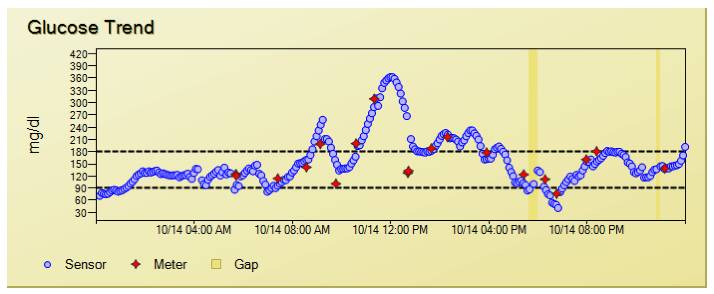
I'm including a graph showing the DexCom values and my BG values during the ride. I ate a banana around 8 AM and took about half of my regular dose. Later, after noticing that my BG's were rising more than I was happy with, I took my full dose. We started riding around 9:20 AM. Unfortunately, the software doesn't have any other graphing options for the time axis, but somewhere around 10 AM I noticed that my BG was falling, much more than represented by the DexCom. I ate a Luna bar + 1 GU and didn't take any insulin. You can see the large peak from this snack. I am so worried about dropping low when I exercise that I often end up having some hyperglycemia. I didn't take any insulin for the rest of the ride, but did eat another Luna bar and a couple more GU's at some point. We finished riding sometime around 1:30 PM.
What I might do next time is eat just the Luna bar or the GU and then eat again in another 40 minutes. I've learned that I do often overreact to falling BG's and that it doesn't always take a huge intake of carbohydrates to correct it. I have had an experience in a race where I ate several GU's, a PowerBar and a bag of Skittles and still had a hard time keeping my BG in a decent range. But this was probably due to eating too little earlier on, given the intensity of my ride. I think that, as long as I haven't had a huge insulin bolus recently, I can probably keep my BG's stable on an ride with carb intake every 30-60 minutes, depending on the intensity of the ride.
Diabetes and Stem Cells: UCSF Mini Med School
I'm not exactly sure how I will be able to view this, but I thought I would announce that the UCSF Mini Med School is giving a lecture tonight on stem cells and the potential for treating diabetes. It is being broadcast on UCTV.
From the link:
"Join Dr. Michael German, the clinical director of UC San Francisco's Diabetes Center, as he explores the steps human embryonic stem cells take to become insulin producing pancreatic islet cells, and the goal of clinicians to transplant these cells to treat diabetes."
I think you can watch UCTV online.
From the link:
"Join Dr. Michael German, the clinical director of UC San Francisco's Diabetes Center, as he explores the steps human embryonic stem cells take to become insulin producing pancreatic islet cells, and the goal of clinicians to transplant these cells to treat diabetes."
I think you can watch UCTV online.
Friday, October 13, 2006
Inspiration
As we move through the last few months of 2006, my training for Ironman Couer d'Alene is beginning to pick up. Although I am usually highly motivated to train, it can get frustrating sometimes dealing with the diabetes stuff, and just trying to balance the training with everything else that is important in my life.
A friend recently showed me this video about Team Hoyt: a father-and-son team that competes in marathons and triathlons. They became most well-known for competing annually in the Boston Marathon, and I saw them race when I was a student in Boston. The unique thing about Team Hoyt is that Dick Hoyt, the father, pushes or pulls his son, Rick, the entire distance.
So when I get frustrated that my run is getting sidelined by a low BG (which doesn't actually happen often), I can remember these guys. Here's a video from YouTube.
A friend recently showed me this video about Team Hoyt: a father-and-son team that competes in marathons and triathlons. They became most well-known for competing annually in the Boston Marathon, and I saw them race when I was a student in Boston. The unique thing about Team Hoyt is that Dick Hoyt, the father, pushes or pulls his son, Rick, the entire distance.
So when I get frustrated that my run is getting sidelined by a low BG (which doesn't actually happen often), I can remember these guys. Here's a video from YouTube.
Thursday, October 12, 2006
No Symlin Yet
I went to pick up my prescription from Kaiser today and was handed a bill for $658. Needless to say, I declined the prescription. I was really disappointed, because I was excited to give this a try. I guess Kaiser doesn't cover Symlin for some reason. The $658 would have purchased 6 vials of 5 mL each, which, from my rough estimation, would last me 3 months at the very minimum. So the cost of Symlin would be more or less on par with Humalog. Additionally, I would need less Humalog so that cost would be reduced. I am going to try and appeal this decision. If Kaiser wants to live up to their "Thive" campaign, one would think that they would be supportive of those patients who are really eager to take preventive measures.
Not Perfect
So some days are better than others when it comes to diabetes management. I put a new sensor in for my DexCom 2 nights ago, and expected it to work as accurately as the first. By the way, the only reason I removed the first sensor after 7 days (instead of the billed 3 days per sensor) was that my skin started to get irritated around the sensor, and I was worried about infection. Actually, when I removed the sensor, I decided that I probably could have left it in longer. The skin under the tape looked fine and the site where the sensor wire had been also looked fine (although there was and still is a very small bump there under my skin). Anyway, after putting in the new sensor, I started the 2-hour calibration period and went to sleep. I woke up around 2 AM to the beeping sound of the Dexcom, prompting for two BG samples. I uploaded those and went back to sleep. When I woke up in the morning, I was sad to see that my meter hadn't read any values all night, but relieved that they started showing up after I input another BG value.
Unfortunately, sporadically during the day, the DexCom would fail to pick up some readings, even though I kept the meter close by. On two occasions since yesterday, my BG dropped to the 40's while the DexCom still read >100. I have my low alarm set for 90 because there can be some delay in the CGMS reading, especially when the BG is changing rapidly. After both of these lows I input the BG value and got major calibration errors, suggesting that I replace the sensor. I decided to wait it out and see if it would start working again, which it did both times. After it failed again right before my track workout, I threw it in my bag and later reset the sensor entirely (which requires another 2-hour calibration period). I just finished that and it seems to be reading okay again so far. We'll see how it goes.
I do feel that the DexCom company is very willing to help me sort out these problems, and am optimistic that as time goes by, I will be able to figure out how to make this technology work better for me. I at least had one really good week with the DexCom, which gives me hope that it will be useful still. I guess I am disappointed with this sensor because I had already grown accustomed to having the CGMS info, and feel at a loss without it. I am also happy that I can apparently get at least 6 or 7 days out of each sensor, which will cut down on the costs significantly.
Unfortunately, sporadically during the day, the DexCom would fail to pick up some readings, even though I kept the meter close by. On two occasions since yesterday, my BG dropped to the 40's while the DexCom still read >100. I have my low alarm set for 90 because there can be some delay in the CGMS reading, especially when the BG is changing rapidly. After both of these lows I input the BG value and got major calibration errors, suggesting that I replace the sensor. I decided to wait it out and see if it would start working again, which it did both times. After it failed again right before my track workout, I threw it in my bag and later reset the sensor entirely (which requires another 2-hour calibration period). I just finished that and it seems to be reading okay again so far. We'll see how it goes.
I do feel that the DexCom company is very willing to help me sort out these problems, and am optimistic that as time goes by, I will be able to figure out how to make this technology work better for me. I at least had one really good week with the DexCom, which gives me hope that it will be useful still. I guess I am disappointed with this sensor because I had already grown accustomed to having the CGMS info, and feel at a loss without it. I am also happy that I can apparently get at least 6 or 7 days out of each sensor, which will cut down on the costs significantly.
Monday, October 09, 2006
Overnight Highs...
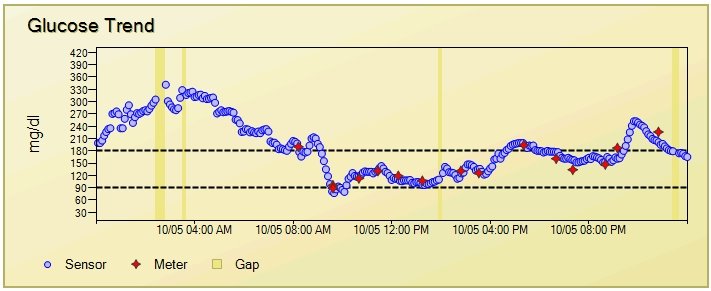
Here is one day from the DexCom, using the software that arrived in the mail today. As you can see, I had a bit of trouble overnight on this date. Since I often get up very early--around 5 AM is not uncommon--I am considering starting my early morning basal rate increase a few hours earlier. I've noticed this same pattern on other days; although, it isn't completely consistent. I've only been on the DexCom for a week now and am gaining new insights into my glucose management every day.
Also, I should mention that I am now beginning day 7 on my first sensor, and it seems to be as accurate, if not more so, than day one. So the costs of using the Dex may be much less than initially feared. Plus, I am learning how to trust it more, and am gradually reducing the number of BG measurements to a more reasonable amount. I think I burned through a whole vial of test strips on day 1.
Having a CGMS allows me to really use the fine dosing capabilities. I wouldn't have had the confidence to correct for a BG of 150 previously. But if I can float along at 100 instead of 150, why not?
Friday, October 06, 2006
My Kind of Crackberry?
If you haven't heard, many people give the popular phone/PDA Blackberry device the nickname of "Crackberry." Here is a good description of why the Blackberry earned such a nickname: "CRACKBERRY: Another name for the Blackberry that refers to its addictive nature and the inability of its users to focus on anything else for more than 10 seconds." Another article by ABC compares the Blackberry addiction to other serious addictions like alcohol or drug abuse. There are even rehab programs developed for people with email addictions.
It's been 2 days with the DexCom now and I have to wonder if I can leave it alone for more than 10 seconds... or at least long enough to check my email.
It's been 2 days with the DexCom now and I have to wonder if I can leave it alone for more than 10 seconds... or at least long enough to check my email.
Subscribe to:
Posts (Atom)