Friday, March 25, 2011
Survey on Exercise and Motivation
I am working on a post about what motivates people to exercise. If you'd like to contribute, please share your thoughts at this poll. Thanks!


Wednesday, February 09, 2011
Intensity and Blood Sugar
When I was diagnosed with type 1 diabetes, one of the guidelines I was given was that exercise would make my blood sugar drop. Like most guidelines I received, this was an oversimplification. During my years of daily running, I would go out the door without eating or taking any insulin, and often return with a slightly higher BG level. I remember thinking, "'Guess I'm just weird." And during track workouts, the response was even more perplexing. After a few intervals at high intensity, my blood sugar would really start to climb. I grew accustomed to this response and began taking some correction boluses or temporary basal rates to help temper the steep rise. What I have learned since then, and which has hopefully become more common knowledge, is that high intensity physical efforts can increase the adrenalin and stimulate the liver to release more glucose into the bloodstream. (Here is an article that explains the phenomenon and suggestions for how to manage it. Also, fellow type 1 and exercise guru, Dr. Sheri Colberg-Ochs, has an excellent book devoted to the nuances of diabetes control and exercise.)
I think there is another reason that exercise does not always cause my blood sugar to drop, even when I am doing a more moderate-intensity workout: I have basically adjusted my basal rates to account for morning exercise, and I am consistent in exercising almost daily. So, instead of constantly reducing my basal rate, I try to remember to increase it on my off days. Of course, with anything diabetes-related, things don't always work out as planned--there are still days when I have to eat 3 gels to get through an hour of exercise!
When I first start a new exercise type, or increase volume and/or intensity of my current regimen, I will typically notice an increase in insulin sensitivity, as manifested by more frequent low blood sugar (unless I catch on early and adjust my basal rates). This can be significant, especially initially; over a few weeks, the effect seems to be reduced, although I will still be more insulin sensitive than prior to the change in exercise (up to a point). I remember, when I first started doing triathlon, I had a couple hours in the afternoon where I had to shut my pump off. My body adapted to the changes and the effect did not last for more than a week or so; but still, I had an overall, significant decrease in my daily insulin dose that persisted. I had been running 6 days/week for years so initially, at least, it was primarily the change in exercise type that was responsible for the effect.
When this effect diminishes and my insulin needs increase a little, I see it as a sign that my body is becoming more efficient at the exercise and that my fitness is improving. Or maybe it's just time to take it up a notch again.
I regularly attend a bike class that has efforts mainly in my upper power zones, equivalent in intensity to a track workout for running. It takes a lot of focus to keep my intensity high because, basically, it hurts. I have been watching my CGM during class to see what types of intervals cause my glucose levels to rise or fall. Today's workout called for a five-minute warmup followed by isolated leg drills. We then moved into two five-minute high cadence intervals, following by two sets of six minutes at low cadence followed by a minute rest and then six minutes at high cadence. These were all hard efforts and I tried to push it as hard as I could. I came into the class right around 100 mg/dL and held off on eating anything. For the first half-hour, things remained steady. I expected to see a rise after the two high cadence intervals, but it remained steady. However, about 10 minutes later, there was a slight increase, which is the first bump you can see on the CGM display. This came back down somewhat and I remained in a good zone throughout the class. The high cadence intervals feel a lot harder to me; it takes much more determination to stay at 115 RPM for six minutes for me to do the equivalent Watts at 65 RPM. For me to have the same heart rate at 65 RPM, I can increase my Watts by about 30. This may explain my general observation that the high cadence intervals stimulate a greater blood sugar increase than the low cadence intervals. Perhaps, today, the alternating high then low cadence intervals kept things more steady. I need more data and translating this to the road may not be totally straightforward. But I will add that the only bike race where I have had low blood sugar was the hill climb at Kern County Women's Stage Race. (Of course, the hill climb being the second race of the day muddies the waters a little.)
Oh and now you can see, perhaps, why I want to have the power meter (and/or other fitness devices) and CGM all integrated. I won't go off on another rant right now since I already took care of that here!
And one more thing: I think this stuff also applies to athletes without diabetes. I am surprised that people haven't started using these tools to refine athletic performance. Seriously, people pay big bucks to save 10 grams on their wheel, which is absolutely meaningless if you don't fuel properly and get sub-optimal blood sugar during a race. It is really hard to nail down blood sugar levels unless you actually measure them. (For example, I have bonked with normal blood sugar.) And as luck would have it, there are plenty of tools to do so. I would love to see some top athletes show their data during races, for example. Bueller? Bueller? Anyone?
Addendum: I'd like to add a reminder that exercise can of course cause a drop in blood glucose, which can become life-threatening if treatment (i.e., a carbohydrate source or glucagon) is not available. I almost always have at least 50-75 g of fast-acting carbs with me, and more if I am exercising >1 hour or somewhere without quick access to a store etc. And I always bring along the CGM and/or BG meter. (I rely on the CGM alone for workouts <2-3 hours, but will bring the meter as well if I'm going longer.) Don't make fun of the bulging pockets on my jersey!
I think there is another reason that exercise does not always cause my blood sugar to drop, even when I am doing a more moderate-intensity workout: I have basically adjusted my basal rates to account for morning exercise, and I am consistent in exercising almost daily. So, instead of constantly reducing my basal rate, I try to remember to increase it on my off days. Of course, with anything diabetes-related, things don't always work out as planned--there are still days when I have to eat 3 gels to get through an hour of exercise!
When I first start a new exercise type, or increase volume and/or intensity of my current regimen, I will typically notice an increase in insulin sensitivity, as manifested by more frequent low blood sugar (unless I catch on early and adjust my basal rates). This can be significant, especially initially; over a few weeks, the effect seems to be reduced, although I will still be more insulin sensitive than prior to the change in exercise (up to a point). I remember, when I first started doing triathlon, I had a couple hours in the afternoon where I had to shut my pump off. My body adapted to the changes and the effect did not last for more than a week or so; but still, I had an overall, significant decrease in my daily insulin dose that persisted. I had been running 6 days/week for years so initially, at least, it was primarily the change in exercise type that was responsible for the effect.
When this effect diminishes and my insulin needs increase a little, I see it as a sign that my body is becoming more efficient at the exercise and that my fitness is improving. Or maybe it's just time to take it up a notch again.
 |
| bike class at the beginning |
Oh and now you can see, perhaps, why I want to have the power meter (and/or other fitness devices) and CGM all integrated. I won't go off on another rant right now since I already took care of that here!
And one more thing: I think this stuff also applies to athletes without diabetes. I am surprised that people haven't started using these tools to refine athletic performance. Seriously, people pay big bucks to save 10 grams on their wheel, which is absolutely meaningless if you don't fuel properly and get sub-optimal blood sugar during a race. It is really hard to nail down blood sugar levels unless you actually measure them. (For example, I have bonked with normal blood sugar.) And as luck would have it, there are plenty of tools to do so. I would love to see some top athletes show their data during races, for example. Bueller? Bueller? Anyone?
Addendum: I'd like to add a reminder that exercise can of course cause a drop in blood glucose, which can become life-threatening if treatment (i.e., a carbohydrate source or glucagon) is not available. I almost always have at least 50-75 g of fast-acting carbs with me, and more if I am exercising >1 hour or somewhere without quick access to a store etc. And I always bring along the CGM and/or BG meter. (I rely on the CGM alone for workouts <2-3 hours, but will bring the meter as well if I'm going longer.) Don't make fun of the bulging pockets on my jersey!
Thursday, January 13, 2011
A Few Requests (Short of a Cure)
 |
| "I'm melting!" |
But wait. I have more requests. Short of a cure, here are a few things on my diabetes wish list:
1) Blood insulin meter. Let's say it's been 2 hours since my injection and I'm about to go exercise. Wouldn't it be handy to just be able to know how much insulin is really still active? Or how about when my blood sugar is 400 and I take a huge bolus to correct and two hours later I'm still at 400. What happened to all that insulin? Is it just hanging out, waiting to crush me later? How could I know? Bolus up, maybe do a super bolus, and hope for the best! Or be conservative and watch the BG hover up there for hours. I imagine the metabolism of insulin varies a lot depending on many factors but no one really seems to discuss this much, probably because we (as patients) have no way to measure it. And what about being able to pinpoint that the infusion site is bad vs I am coming down with a cold or maybe that day off from exercise is affecting me more than I expected. So many variables! This could help significantly to cut down on the guesswork.
2) Stable glucagon in a pen delivery device. One of those glucagon kits is $100 and can't really be used more than once according to enclosed instructions. Sure it's easy to eat food and doesn't require an injection. But seriously, I don't care about injections. Those pen injectors are pretty slick. What I want is good glucose control and to not have to eat 500 calories in a day to treat a low. I don't want to go drink some soda after I overestimated the carbs in a filling meal. I just don't want to HAVE to eat. Especially after I just brushed my teeth for the 3rd time. Maybe it sounds petty to some people but I just wish I didn't have to make food and carbs such a focus of my life. Let me introduce a little distance between food as nourishment and food as the thing that makes all my crappy feelings (i.e., hypoglycemia) go away.
3) Data integration with non-diabetes devices. FREE THE DATA! Free it! Do it! Do it now!! Hey diabetes technology people! Hey FDA! Design your devices so they are safe but let us capture the data in a way that we can use how we want! I am not a moron! This is perhaps the thing that drives me the most nuts. There is absolutely no reason technology-wise that the continuous glucose meter data, for example, should be restricted from streaming to my iPhone or workout device. Arghhh! I have to stop writing about it because it is so incredibly frustrating. I know there is a lot of work on this but there shouldn't have to be any. Free the data and people will design apps. FDA are you listening?!
Okay, those three things are probably enough for now. If the list is too daunting, let's just get that cure all sorted out. Thanks!
Tuesday, November 09, 2010
What I Wish People Knew About Diabetes
Part of the joy of attending events such as a JDRF ride or a triathlon with Triabetes is being surrounded by people who really "get it" with respect to having type 1 diabetes and trying to live a full and active life. I have also been fortunate to have many close friends and family members without diabetes who have taken time to learn and have been patient as I rambled on about my experiences managing my diabetes. In my mind, I carry a little corner of worry--or perhaps "attention" is a better word, depending on the circumstances--about my blood sugar and insulin levels and how they are changing, and how they might be affected by anything else happening. For example, I may be running, watching my blood sugar falling and thinking, "Hmm, can I beat this or am I going to have to eat something before I finish up in 15 minutes?" Or maybe on a long bike ride I may see my blood sugar rising and wonder whether that half-of-a-unit will be enough or should I risk having to eat more later or getting a low blood sugar because I treated it more aggressively. Being able to share these moments with a friend who understands, or is willing to learn how to understand, eases my worry. Knowing that there is at least one other person nearby who understands what it might mean for me to see "42" on my meter helps me to feel so much less vulnerable. When I was in a crash at a criterium in February, 2009, the medical staff person (thank you Katherine H!) for the race came over and said that she was a nurse and experienced with diabetes; a wave of relief passed through me. "My blood sugar was 250 before the race and now my pump is broken! I'm on Humalog!" She knew exactly why I was worried and was able to find my meter for me and communicate my concerns to the EMTs. This was a tremendous comfort to me during a truly frightening and painful experience.

What do I wish people knew about diabetes? Honestly, there is so much to learn and so many other diseases and medical conditions that people may need to focus on in their own lives, that I wouldn't expect anyone to become an expert on diabetes unless it were required of them or else they had a particular interest. I would hope that people are aware of the signs & symptoms of both type 1 and type 2 diabetes, since delaying a proper diagnosis can lead to a great deal of unnecessary suffering. Also, there is a type of diabetes called "1.5" or LADA, which presents more like type 2 but which is actually a slow-onset version of type 1 (and is often misdiagnosed). I wish more people appreciated the dramatic effect of exercise and diet on their metabolism and worked to prevent the onset of type 2 as much as possible. Diabetes is no joke. Still, I think it is unhelpful to make assumptions about either type 1 or type 2 diabetes unless one has already gained some actual fact-based knowledge on the topics, and met quite a number of people who actually have type 1 or type 2 diabetes.
But if you happen to be a friend of a person with diabetes (and I will focus on type 1, since that is my area of expertise, so to speak), and want to be someone who "gets it," here are a few starting points:
1) Type 1 diabetes does not have a cure, although there are a lot of exciting lines of research. I am 100% uninterested in anyone claiming to have an "unknown" or "magic" cure. Really, once it is found, I am sure it will not be a secret for long. I will take insulin until a cure is found. Although changing my diet and exercising will affect the way I manage diabetes, it does not cure me of it. Type 1 diabetes is caused by an auto-immune process that seems to be triggered by something environmental. The exact cause is unknown. Although it is more common in kids and young adults, it can occur at any age.
2) Insulin is a hormone made in the pancreas by the beta cells. In type 1 diabetes, the beta cells get destroyed and the insulin must be replaced through injections (via an insulin pump, syringes, or pens). Insulin is required 24 hours per day, even when fasting. I take a background rate of insulin ("basal rate") to cover basic metabolic needs, and take a "bolus" (like an injection) when I eat anything with carbohydrates. High fat and/or protein foods also require insulin over longer time period. Food gets converted into glucose (in varying proportions) which eventually enters the bloodstream, causing a rise in the blood glucose level. Insulin lowers the glucose concentration in the blood by facilitating transport into fat and muscle cells.
4) Although the normal blood glucose for someone without diabetes is typically 70-90 mg/dL and temporarily a bit higher after a meal, my blood sugar can be anywhere. If you ask me what my "normal" blood sugar is, I might give you a blank stare. I try to keep it above 70 and otherwise as low as possible given the situation; I guess my target is around 110. When I am exercising I will usually keep it a bit higher, since it can fall very quickly. I have had readings below 20 and above 600, otherwise known as "LO" and "HI" on the blood glucose meter. It can fall and rise really fast; but sometimes it can take forever to budge. Low blood sugar makes me feel really weak and also scared, if it is quite low. I am still able to communicate (this is not universal) but I may speak slower and act a little dazed. I really hate having low blood sugar. High blood sugar can make me sleepy and/or moody and it sometimes feels like a mild stomach flu. I get thirsty and can become dehydrated more easily. Sometimes my arms will cramp. Things that lower my blood glucose include: insulin, exercise, not enough food. Things that can raise my blood glucose include: food, stress & anxiety, exercise, too little insulin. These are not the complete lists. On my pump, I have different basal rates for the different times of day. I also take a certain amount of insulin in response to the amount of carbohydrates in a meal and another amount to correct for a high blood sugar.
5) Exercise can lower or raise my blood sugar in the moment. In the long run, the increased insulin sensitivity due to exercise makes it easier for me to alter my blood sugar and allows me to take less insulin overall. During exercise, I am exquisitely sensitive to insulin. For example, I may take 3 units for 45 grams of carbohydrate normally; but when exercising, I might just take 0.5 unit. Frequently, I may not even take any insulin at all, other than my ongoing basal rate. Stopping for too long to eat in the middle of an exercise session can make it difficult, because then I will either need to bolus for the food or will watch my blood sugar start to climb. If I take a normal bolus, and then start exercising again, all the insulin in my body becomes supercharged and my blood sugar may come crashing down. Then I have to eat more, which is really annoying to me, or I will have to stop, which is even more frustrating. I could compromise and take a partial bolus and this is often what I do. But there is a bit of uncertainty about how much to take and then all I get to think about for the next couple hours is whether my blood sugar is going to crash. This is why I may get eager to get going again; really, I can relax!
6) I plan my insulin and meals around my exercise. If there is a big change in schedule, this can make it more difficult. I may have changed my insulin dosages in anticipation of a race or workout start time. If there is a big change, then I will need to compensate for that. This could require me to eat 2-3 extra GUs to get through a run (boo!) or could result in a super high blood sugar for the first hour of a bike race. I realize changes happen and try to be flexible.
7) Please don't ditch me if I have to stop to test my blood sugar. I usually try to test when people are stopped for some other reason. I don't get bothered by most things, but getting left behind on a ride because I needed 45 seconds to check my blood sugar makes me want to cry. Fortunately this rarely happens anyway, and having a continuous glucose meter means I just have to pull it out and take a look.
8) If you find yourself surrounded by some PWD (people with diabetes), just throw out the question, "What's the fastest way to raise a low blood sugar?" and you will keep the conversation going for at least 10 minutes. In general, simple carbs without fat or protein absorb quickest and are best for treating low blood sugar. How much I need to eat depends on how much insulin I have in my system, how fast I may still be dropping (i.e., how fast my blood glucose is dropping), if I am exercising or planning to exercise, if I ate something else already, etc. I try to carry enough sugar to feed 100 hypoglycemic PWD but if a friend happens to carry a spare GU, that certainly could come in handy. Foods that help me bring up a low blood sugar include: glucose tablets, Skittles, Smarties, juice, milk, energy gels (like GU), soda, honey (but eat carefully--I seriously choked once eating honey too fast during a low), corn syrup, etc. Foods I wouldn't target but could bring up my blood sugar more slowly include: bread, fruit such as apples/bananas, candy with a lot of fat, granola bars, crackers, cake. Foods that won't help include: pure protein (steak, chicken, cheese, eggs, etc.), nuts, non-starchy vegetables, lard (hey just seeing if anyone is actually reading this).
Well, I could go on but anyone reading this probably either knows this stuff already or is now completely overloaded. Perhaps most importantly, what I would like people to know is that I and most people with diabetes are always willing to answer questions, as much as you are interested. Personally, I don't expect people to know too much about the particulars, just as I don't know the ins and outs of most other chronic diseases. So if a friend says, "Hey does insulin cause your blood sugar to go up or down?" I am not thinking, "What a dufus!" I am sincerely glad to explain it because your just asking about it makes me feel more supported. And I believe that PWD have insights gained through their unique window on their own metabolism that can be enlightening to anyone, with or without diabetes. Finally, I believe that as the incidence of diabetes continues to increase, PWD who have observed the dramatic changes in metabolism related to insulin, exercise and diet are in a unique position to support efforts to prevent type 2 and to help people improve their management of both type 1 and type 2 diabetes.
(See other blog posts addressing this diabetes blog day topic.
I was supposed to just name 6 things but I got a little carried away. Oops.)
Wednesday, October 06, 2010
Triabetes documentary tonight in San Francisco
Please join us tonight at 7 PM at University of California San Francisco for the Northern California premiere of the Triabetes documentary: "The Science of Inspiration."
Here's the info:
In 2008, 12 people with type 1 diabetes, including myself, set out to complete Ironman Wisconsin as part of a team called Triabetes. Triabetes has now grown to be the world’s largest triathlon club for people with diabetes, shattering presumed limitations and revolutionizing the way people approach diabetes management.
Come meet current Triabetes members, and join us for an evening of inspiration, education and exploration as we follow these athletes and the kids who partnered with them for their journey to the finish line and beyond.
Tickets are free; $5-10 donation welcome at the door. There will be raffle prizes awarded at the end!
See the preview here: http://vimeo.com/1871013
Location:
513 Parnassus Avenue, San Francisco
Cole Hall (first floor of 513)
7 - 9 PM
Parking is available across from the main hospital in public lots or you can take N Judah to Arguello/Irving and take the parking elevators all the way up to Parnassus. Buses 43 and 6 will drop you off right at 513 Parnassus. Free parking is usually discoverable in the neighborhood if you are persistent.

Here's the info:
In 2008, 12 people with type 1 diabetes, including myself, set out to complete Ironman Wisconsin as part of a team called Triabetes. Triabetes has now grown to be the world’s largest triathlon club for people with diabetes, shattering presumed limitations and revolutionizing the way people approach diabetes management.
Come meet current Triabetes members, and join us for an evening of inspiration, education and exploration as we follow these athletes and the kids who partnered with them for their journey to the finish line and beyond.
Tickets are free; $5-10 donation welcome at the door. There will be raffle prizes awarded at the end!
See the preview here: http://vimeo.com/1871013
Location:
513 Parnassus Avenue, San Francisco
Cole Hall (first floor of 513)
7 - 9 PM
Parking is available across from the main hospital in public lots or you can take N Judah to Arguello/Irving and take the parking elevators all the way up to Parnassus. Buses 43 and 6 will drop you off right at 513 Parnassus. Free parking is usually discoverable in the neighborhood if you are persistent.

photo courtesy of Blair Ryan
Tuesday, September 21, 2010
Twenty-two years
Twenty-two years ago today, I was pulled from 9th grade gym class at Highland High School and made my way to Primary Children's Hospital in Salt Lake City, where I was diagnosed with type 1 diabetes. I started using Regular and NPH insulin and learned how to test my blood sugar on an early model One Touch meter. It took me fifteen minutes to poke my finger the first time. I continued on the cross country team and since then I have run twelve marathons, qualified for and run the Boston Marathon, completed four Ironman triathlons, and competed in about 30 road bike races. I would give anything to be able to go just one mile without diabetes. Today I am raising money for a cure for type 1 diabetes with the JDRF for all of us with type 1 diabetes and in honor of those who have been taken from us too soon. Please donate generously if you are able; any amount is welcome. Donations can be made at my page at http://ride.jdrf.org/rider.cfm?id=9740.
Tuesday, September 07, 2010
Riding Again
Earlier this year, when in Wisconsin for the funeral of Jesse Alswager, I decided that I would like to join Jesse's mom, Michelle, as she and a number of friends chose to honor him by riding at the Juvenile Diabetes Research Foundation's Ride to Cure Diabetes in Death Valley, California, on October 16, 2010. Since then I have become aware of similar stories of great loss, including the deaths of several young people close in age to Jesse. I have tried to live with a philosophy that diabetes is more of an inconvenience than a death sentence; still, these heart-wrenching events have touched me and reminded me that insulin and all of our wonderful technological advances still allow too many to slip away. It is still hard for me to reconcile these events, knowing that I share the same condition.
After my accident at the velodrome in May, I wasn't sure what the next few months would hold, and whether I would be able to continue with my plans for Death Valley. The collarbone surgery was successful, but I would need to take blood thinners (warfarin) for up to 6 months to help treat three clots that had formed in my lungs. The scare tactics from my physicians were pretty effective and I felt discouraged that I would not be riding for the rest of 2010. Slowly, though, I was connected with other athletes on warfarin and realized that some riding would be okay. A month after the crash, I was elated to be out riding again. I chose the safest routes I knew, and backed off a little on the descents and when approaching intersections. I spent more time indoors on the rollers, and also picked up swimming and running again. Road racing and other large group rides were out of the question. But, fortunately, my time on the warfarin was shortened to just three months, and I am happy to now be riding warfarin-free as of this past weekend. (This experience has given me an appreciation for those who must remain on warfarin for life--a topic for another post.)
I decided to continue with my plans to ride in memory of Jesse, Trent, and all the other people whose lives have been shortened by this disease. I will also ride in support of their families. Additionally, I will ride to honor those who currently face a daily struggle due to serious complications of diabetes. I am fortunate and grateful to be in good health and to be able to pursue my dreams. Finding a cure is the best way to ensure that all people with type 1 diabetes can continue on that same path.
I would be touched by your donation. If you are able to donate, please go to my JDRF page here. Any amount is helpful and welcome, and you can donate anonymously if you would like.
After my accident at the velodrome in May, I wasn't sure what the next few months would hold, and whether I would be able to continue with my plans for Death Valley. The collarbone surgery was successful, but I would need to take blood thinners (warfarin) for up to 6 months to help treat three clots that had formed in my lungs. The scare tactics from my physicians were pretty effective and I felt discouraged that I would not be riding for the rest of 2010. Slowly, though, I was connected with other athletes on warfarin and realized that some riding would be okay. A month after the crash, I was elated to be out riding again. I chose the safest routes I knew, and backed off a little on the descents and when approaching intersections. I spent more time indoors on the rollers, and also picked up swimming and running again. Road racing and other large group rides were out of the question. But, fortunately, my time on the warfarin was shortened to just three months, and I am happy to now be riding warfarin-free as of this past weekend. (This experience has given me an appreciation for those who must remain on warfarin for life--a topic for another post.)
I decided to continue with my plans to ride in memory of Jesse, Trent, and all the other people whose lives have been shortened by this disease. I will also ride in support of their families. Additionally, I will ride to honor those who currently face a daily struggle due to serious complications of diabetes. I am fortunate and grateful to be in good health and to be able to pursue my dreams. Finding a cure is the best way to ensure that all people with type 1 diabetes can continue on that same path.
I would be touched by your donation. If you are able to donate, please go to my JDRF page here. Any amount is helpful and welcome, and you can donate anonymously if you would like.
Wednesday, June 23, 2010
Velodrome Crash: the Long Story
I had been interested in racing the track for a while, but didn't have the confidence to try it out. After a clinic last December, another 2-day clinic about a month ago, and then a great workout session the night before, I felt comfortable racing at the Hellyer Velodrome's “Get Ready for Summer” races on Saturday, May 29, 2010. We would have our own women's category 4 field, rather than race with the guys. The first race was a tempo race, with points given each lap for the 12 laps. I think I came in first or maybe second for a couple laps, and I ended up placing third overall. Our next race was a 12-lap scratch race, which is like a criterium in that the winner is determined by who finishes the whole thing first.

Throughout the race, I felt like people were squeezing the group somewhat down track (i.e., towards the inside); for me to move around I would go up and around and advance. I realized partway through that I did not feel comfortable advancing my position, and settled somewhere towards the back, looking for a good opportunity. With three laps to go, I was in the sprinter's lane (the innermost lane on the track) behind a line of riders. We were approaching turn three. I have a few seconds of memory lapse here but the next thing I recall is riding on the apron pavement towards the warmup circle (in the infield area) and seeing someone down immediately in front of me. I had nowhere to go. It was a déjà vu moment from last year as I flew over my handlebars and hit the ground. Stars flashed and I came to a stop, sitting up. I assessed the situation and immediately felt relief--no great pain. Maybe I wasn't that hurt. But moving a little, I was certain my right collarbone was broken. I felt angry, mostly, and was pretty quiet. I noticed some blood trickling down my face and people were coming over. It was very sunny, bright and hot sitting there on the black asphalt.
People began helping me while we waited for the ambulance. The initial numbing shock started to wear off and I could feel the pain increasing, mostly in my shoulder. Since I couldn't lie down, and I had hit my head, a friend stabilized my neck while I sat. It was quite a while, so thank you, Evan. I felt bleeding in my pelvic area and thought for sure there must be blood gushing. Once the paramedics arrived, I heard the words "dislocated" and "deformed" with regard to my shoulder, and was not amused. The thought of someone pulling my arm to put it back in place was horrifying. They were good about not forcing a certain position and got me on the spine board (yeah, here we go again) and into the ambulance. I asked for morphine since last year I didn't get pain medication quickly enough. The paramedic continued asking me questions and I felt sleepy but he didn't want me sleeping, I guess. I felt like I was still bleeding in my pelvic area and mentioned it again. But the bleeding was internal; the paramedic put an ice pack there and also one on my shoulder, which brought some relief. I was most impressed that he was able to start an IV while the ambulance was moving without jabbing me all over.
I arrived at the Regional Medical Center San Jose, the closest trauma center, and things got busy. I was very happy to see two good friends, Rita and Amy, waiting there for me. The ER staff did some Xrays and other exams and cut off my favorite bib shorts and team jersey. It wasn't until we were there for some time that they noticed a puncture wound on my shoulder, and soon discovered that the clavicle fracture was open, meaning that it had broken through the skin. This has been my nightmare and the ultimate in bad injuries! Ahhh! The surgeon came in and numbed it, thinking he could perhaps set it in the ER. I felt and heard him tapping on the bone (ugh!) but at least it didn't hurt. It became clear that surgery would be required. Later I learned that the clavicle had fractured, completely shredding the ligaments attached to the scapula below, and piercing through the trapezius muscle and out through the skin. Somehow it had also retracted back in a bit; so there wasn’t a huge piece of bone sticking out, at least.

I was scheduled for surgery as soon as possible, the next morning. They admitted me from the ER and put me on morphine to help with the pain. I was nervous about the surgery but was comforted by the company of good friends. They wheeled me to the OR where the surgeon explained his plan to repair the torn ligaments and to stabilize the fracture using a surgical device called a "tight rope." Also, the anesthesiologist and I discussed diabetes management; he was interested in my Dexcom CGM, which he kept with him during the surgery. The next thing I remember was waking up with severe pain in my shoulder. I was in a daze the rest of the day and would briefly see my friend Rita every now and then when I woke up. Thanks for staying with me all day. After some physical therapy to get me moving a little the next day, Monday, I was ready to go home. I wanted to get back to San Francisco; if I needed further medical care, I preferred to go to my regular doctor. Also, it was so hot in that hospital that I was constantly sweating and uncomfortable. My friend June from my bike team stopped by after the Memorial Day Crit and graciously offered to wait for me to be discharged and to drive me home. I was still a bit dizzy and unstable walking around but the medical staff seemed to feel it was okay to leave. I noticed some pain in my right calf that I hadn't felt before.


I was glad to be home and was comforted by my having my roommate Radhika there. Sleeping was still difficult and I woke up that night around 1:30 AM, a bit uncomfortable, but fell asleep again. I had some weird dreams including one where I was outside in a storm at my parents' home in Utah, watching lightning strike uncomfortably close. I thought that I might get struck and then a thick bolt, covered with burning embers, struck my parents' house, causing it to burst into flames. Then the lightning came my way, striking me and throwing me down into a dark pit, where I was burned up. Lovely! I'm so lucky! I woke up at that point to severe pain in my right side. It was around 4:30 AM and I was disappointed I hadn't slept more. I thought I must have jammed my arm into my side or something--that the pain was just from sleeping in a bad position. After standing up and walking around a bit, the pain started to subside. Still, when I would try to lie down again, the pain would return. Last year, the rib and L2 fracture diagnoses took about a week to come in, so I assumed I had just broken a rib that was somehow missed on Xray. Or maybe somehow my side was slightly injured and my sleeping position further injured it. I did sleep again for a bit and after that, I couldn't find any comfortable position. I noticed that the pain in my side was completely eclipsing my collarbone pain.
A good cycling friend (and nurse!), Cheryl, came that morning to help me and stayed for quite some time; I was so grateful for her company and help. I was feeling anxious about being home alone with this pain and was still somewhat lightheaded and unstable at times. I was so happy to finally be able to shower and was put at ease to have her there. Throughout the day, the pain would get worse and then subside again. My doctor felt like the trauma center most likely did not miss a rib fracture and helped me to get a new prescription for pain medication. In the afternoon, a case worker from my health plan called; she was in the process of transferring my medical records from the trauma center, including my radiology images. She asked how I was doing and I told her about the pain, that it was a "10 out of 10" when I tried to breathe deeply. Basically, I could not breathe normally at all. It felt just like a broken rib. She recommended that if it did not improve with the vicodin, that I head to the ER. I took another vicodin and the pain did improve somewhat. But by about 4 PM when my friend Colleen arrived to visit, I felt like it was time to go in. I was mostly worried that my shallow breathing would cause my blood oxygen levels to drop and that that might put any brain injury (if I had one) at greater risk. I was still pretty sure I had a rib fracture--the pain felt very sharp and was consistent with where I fell.
Colleen braved the insanely steep ER driveway in her stick shift car and dropped me off. I was becoming somewhat hysterical because I felt like something was really wrong but I hadn't been able to find an answer. I had tried to get in touch with someone--anyone--to review my Xrays from the trauma center. I knew I would not be able to sleep with this pain. And I was becoming short of breath and very uncomfortable breathing. I was seen very quickly (for an ER) and they started doing tests. Let me tell you--if you have to be in an ER, Colleen is someone you want with you. She had an uncanny way of making me laugh and relax and I was grateful for her company. They did the chest Xrays and didn't find any broken ribs, and also started some blood work. At the last moment, the attending doctor said he would run the D-dimer test to check for blood clots in my lungs. He said that, due to my recent trauma and surgery, the test would likely come back as elevated, and that they would need to do a CT angiogram of my chest in that case. He seemed to feel that it was unlikely that I would have clots, but that they would check it out anyway.
Well, the D-dimer test came back elevated. I asked, "How elevated is it?" and he responded that it is either elevated or not. Oh. I was hoping it would be like having a blood sugar of 150--a little high but not an emergency. I was prepped for yet another CT exam and had the nasty, hot contrast injected as I held my breath. The tech asked if I worked in radiology--I guess because I held still so well? This is something I instruct people to do all the time so I guess I take it seriously when someone asks me to do it! Back in the room, I waited with Colleen for the results. I said, "I doubt it will show anything," and was not overly worried. I didn't really know how serious blood clots were but they sounded bad. After some time, a different doctor came to tell me the results. She seemed serious when she said I had three small clots in my lungs. I don't remember what else she told me but came to understand over the next hour that they would put me on heparin right away and that I would be admitted for treatment. The nurse was having a difficult time getting the IV tubing set up and I was getting increasingly agitated as the doctor tried to explain again what was going on. I asked if I would be okay and the only answer I got was, "It's good you came in." Ugh. They finally got the IV sorted out and injected a huge bolus of heparin. My confidence was sort of shot with that particular nurse and I just hoped she was giving me the right amount. Colleen was there and after the chaos calmed down, I started to relax a little. Over the next hour or two, I could feel the pain lessening in my side with the heparin starting to work. The IV heparin drip would continue for another day or so.

I was moved to the telemonitoring floor where they would be watching my EKG constantly at the nursing station (in case I suddenly keeled over, I guess). I was hooked up to the IV, the EKG leads/box, my insulin pump and had my Dexcom CGM handy. Oh, and of course I had to keep my iPhone by my side. It was impossible to move anywhere without dropping something. I still can't find the clip for my pump so I have been carrying it everywhere. I tried to see how low I could get my heart rate and was sort of disappointed it wouldn't go below 45. I think I can get it to 42 when I am really rested. I was hoping a 45 would set off some bradycardia alarm but alas, they were not concerned. They frequently checked my blood pressure and temperature and regularly drew blood for lab tests. Unfortunately, my veins were not happy and they had about a 30% success rate of finding one. Most of the bruises have just disappeared. They gave me pain medication when I asked, and I should have asked more frequently. I was quickly breaking out in a rash all over due to some allergy and they decided it was probably from the morphine and/or vicodin. I was not happy with the way vicodin was making my head feel, anyway, so we stopped the narcotics around noon on Wednesday. Later, my doctor determined that the allergy was due to the IV cephalexin (antibiotic) I had post-op.
All throughout the day Wednesday, I had a stream of visitors who really kept my spirits up (and kept me distracted from worrying). Those visits, flowers, calls and other help really meant so much to me. Thank you, thank you.
I had an ultrasound exam to check for blood clots in my legs (negative) and a brain CT to check for possible brain injury, since a blood thinner could cause significant complications in that case. I continued to feel sluggish in thinking and speaking, and since I work with people with brain disease and trauma, I know the signs all too well. I was so worried. At one point, the nurse said something that made me really scared and I called my mom and asked her to bump up her flight to that evening, instead of the next morning. I think the comment, "I've had a patient die here from this," was not helpful. I guess I wanted to know how serious it was; I think I would do better with statistics than a horror story, though. After that, the doctor's suggestion that my prognosis was good didn't really stick well.
Thursday morning, I received the news that my brain CT was clear. I was feeling a little more clear-headed and was greatly relieved by these results. The nurses had started me on a twice daily regimen of Lovenox shots on Wednesday, as well as coumadin. The coumadin (i.e., warfarin) is a drug that interferes with blood clotting, and is the drug I will be taking for six months while the clots dissolve. It takes a while to build up, so in the meantime, they wanted me on Lovenox as a backup. Lovenox is a form of heparin that also works to block clotting. The needles are huge and leave bruises that don't want to go away. Since I was comfortable giving myself injections, I was sent home Thursday. Thank you to Alissa for helping my mom with the flowers and for taking me home.

My INR, a measure of clotting time, was 1.5 when I left the hospital; they want me to be at 2-3 for the duration of my treatment. I continued taking the Lovenox shots until the next Monday. Since then, my INR levels have been 2.7, 2.3, 1.7, 1.4 and then 2.6. I will continue going in for blood work a couple times a week until things stabilize better. I have learned that the INR is affected by foods, exercise, sickness, stress, etc., which sure sounds like another fun drug that I get to take all the time (i.e., insulin). But fortunately, there is a clinic with pharmacists who read my results and call me, telling me how much to take for the next few days. I am looking forward to going in for blood work less often, since I'm getting weary of being poked in my arms.
As of now, the pain is gone except for my back and shoulder and occasional headaches. The clavicle is healing well and I can already drive. The road rash has mostly healed. If it weren't for the blood clots, I could imagine being out on the road again in another week. I am still easily fatigued, though, and don't want to ride until I am 100% confident of my upper body stability. Although racing is completely out of the question, I have been told it is okay to ride my bike while taking coumadin, as long as I am extra careful. But since I am always careful, I'm not sure what this will mean for me. I was glad to connect with a few other athletes who have had blood clots and continued training to some degree while on coumadin. Compared to last year, I am physically less injured. But the clots present a different challenge that from here on out, seems more mental. It has been hard.
I am so grateful to the many friends and family who stepped in to help me out, and for your continued support. It would have been impossibly difficult without you. Thank you.

Here are some additional pictures. My mom tells me I should warn you that they could make some people queasy. But I don't think they are so horrible.

I'm #519 in red. photo by Steve Woo
Throughout the race, I felt like people were squeezing the group somewhat down track (i.e., towards the inside); for me to move around I would go up and around and advance. I realized partway through that I did not feel comfortable advancing my position, and settled somewhere towards the back, looking for a good opportunity. With three laps to go, I was in the sprinter's lane (the innermost lane on the track) behind a line of riders. We were approaching turn three. I have a few seconds of memory lapse here but the next thing I recall is riding on the apron pavement towards the warmup circle (in the infield area) and seeing someone down immediately in front of me. I had nowhere to go. It was a déjà vu moment from last year as I flew over my handlebars and hit the ground. Stars flashed and I came to a stop, sitting up. I assessed the situation and immediately felt relief--no great pain. Maybe I wasn't that hurt. But moving a little, I was certain my right collarbone was broken. I felt angry, mostly, and was pretty quiet. I noticed some blood trickling down my face and people were coming over. It was very sunny, bright and hot sitting there on the black asphalt.
People began helping me while we waited for the ambulance. The initial numbing shock started to wear off and I could feel the pain increasing, mostly in my shoulder. Since I couldn't lie down, and I had hit my head, a friend stabilized my neck while I sat. It was quite a while, so thank you, Evan. I felt bleeding in my pelvic area and thought for sure there must be blood gushing. Once the paramedics arrived, I heard the words "dislocated" and "deformed" with regard to my shoulder, and was not amused. The thought of someone pulling my arm to put it back in place was horrifying. They were good about not forcing a certain position and got me on the spine board (yeah, here we go again) and into the ambulance. I asked for morphine since last year I didn't get pain medication quickly enough. The paramedic continued asking me questions and I felt sleepy but he didn't want me sleeping, I guess. I felt like I was still bleeding in my pelvic area and mentioned it again. But the bleeding was internal; the paramedic put an ice pack there and also one on my shoulder, which brought some relief. I was most impressed that he was able to start an IV while the ambulance was moving without jabbing me all over.
I arrived at the Regional Medical Center San Jose, the closest trauma center, and things got busy. I was very happy to see two good friends, Rita and Amy, waiting there for me. The ER staff did some Xrays and other exams and cut off my favorite bib shorts and team jersey. It wasn't until we were there for some time that they noticed a puncture wound on my shoulder, and soon discovered that the clavicle fracture was open, meaning that it had broken through the skin. This has been my nightmare and the ultimate in bad injuries! Ahhh! The surgeon came in and numbed it, thinking he could perhaps set it in the ER. I felt and heard him tapping on the bone (ugh!) but at least it didn't hurt. It became clear that surgery would be required. Later I learned that the clavicle had fractured, completely shredding the ligaments attached to the scapula below, and piercing through the trapezius muscle and out through the skin. Somehow it had also retracted back in a bit; so there wasn’t a huge piece of bone sticking out, at least.

Waiting for the results to come in, I was still
unaware of the compound fracture.
I was scheduled for surgery as soon as possible, the next morning. They admitted me from the ER and put me on morphine to help with the pain. I was nervous about the surgery but was comforted by the company of good friends. They wheeled me to the OR where the surgeon explained his plan to repair the torn ligaments and to stabilize the fracture using a surgical device called a "tight rope." Also, the anesthesiologist and I discussed diabetes management; he was interested in my Dexcom CGM, which he kept with him during the surgery. The next thing I remember was waking up with severe pain in my shoulder. I was in a daze the rest of the day and would briefly see my friend Rita every now and then when I woke up. Thanks for staying with me all day. After some physical therapy to get me moving a little the next day, Monday, I was ready to go home. I wanted to get back to San Francisco; if I needed further medical care, I preferred to go to my regular doctor. Also, it was so hot in that hospital that I was constantly sweating and uncomfortable. My friend June from my bike team stopped by after the Memorial Day Crit and graciously offered to wait for me to be discharged and to drive me home. I was still a bit dizzy and unstable walking around but the medical staff seemed to feel it was okay to leave. I noticed some pain in my right calf that I hadn't felt before.

Before surgery

After surgery: the two metal "buttons" connect the clavicle and
corocoid process via "rope" and constitute the "tight rope."
corocoid process via "rope" and constitute the "tight rope."
I was glad to be home and was comforted by my having my roommate Radhika there. Sleeping was still difficult and I woke up that night around 1:30 AM, a bit uncomfortable, but fell asleep again. I had some weird dreams including one where I was outside in a storm at my parents' home in Utah, watching lightning strike uncomfortably close. I thought that I might get struck and then a thick bolt, covered with burning embers, struck my parents' house, causing it to burst into flames. Then the lightning came my way, striking me and throwing me down into a dark pit, where I was burned up. Lovely! I'm so lucky! I woke up at that point to severe pain in my right side. It was around 4:30 AM and I was disappointed I hadn't slept more. I thought I must have jammed my arm into my side or something--that the pain was just from sleeping in a bad position. After standing up and walking around a bit, the pain started to subside. Still, when I would try to lie down again, the pain would return. Last year, the rib and L2 fracture diagnoses took about a week to come in, so I assumed I had just broken a rib that was somehow missed on Xray. Or maybe somehow my side was slightly injured and my sleeping position further injured it. I did sleep again for a bit and after that, I couldn't find any comfortable position. I noticed that the pain in my side was completely eclipsing my collarbone pain.
A good cycling friend (and nurse!), Cheryl, came that morning to help me and stayed for quite some time; I was so grateful for her company and help. I was feeling anxious about being home alone with this pain and was still somewhat lightheaded and unstable at times. I was so happy to finally be able to shower and was put at ease to have her there. Throughout the day, the pain would get worse and then subside again. My doctor felt like the trauma center most likely did not miss a rib fracture and helped me to get a new prescription for pain medication. In the afternoon, a case worker from my health plan called; she was in the process of transferring my medical records from the trauma center, including my radiology images. She asked how I was doing and I told her about the pain, that it was a "10 out of 10" when I tried to breathe deeply. Basically, I could not breathe normally at all. It felt just like a broken rib. She recommended that if it did not improve with the vicodin, that I head to the ER. I took another vicodin and the pain did improve somewhat. But by about 4 PM when my friend Colleen arrived to visit, I felt like it was time to go in. I was mostly worried that my shallow breathing would cause my blood oxygen levels to drop and that that might put any brain injury (if I had one) at greater risk. I was still pretty sure I had a rib fracture--the pain felt very sharp and was consistent with where I fell.
Colleen braved the insanely steep ER driveway in her stick shift car and dropped me off. I was becoming somewhat hysterical because I felt like something was really wrong but I hadn't been able to find an answer. I had tried to get in touch with someone--anyone--to review my Xrays from the trauma center. I knew I would not be able to sleep with this pain. And I was becoming short of breath and very uncomfortable breathing. I was seen very quickly (for an ER) and they started doing tests. Let me tell you--if you have to be in an ER, Colleen is someone you want with you. She had an uncanny way of making me laugh and relax and I was grateful for her company. They did the chest Xrays and didn't find any broken ribs, and also started some blood work. At the last moment, the attending doctor said he would run the D-dimer test to check for blood clots in my lungs. He said that, due to my recent trauma and surgery, the test would likely come back as elevated, and that they would need to do a CT angiogram of my chest in that case. He seemed to feel that it was unlikely that I would have clots, but that they would check it out anyway.
Well, the D-dimer test came back elevated. I asked, "How elevated is it?" and he responded that it is either elevated or not. Oh. I was hoping it would be like having a blood sugar of 150--a little high but not an emergency. I was prepped for yet another CT exam and had the nasty, hot contrast injected as I held my breath. The tech asked if I worked in radiology--I guess because I held still so well? This is something I instruct people to do all the time so I guess I take it seriously when someone asks me to do it! Back in the room, I waited with Colleen for the results. I said, "I doubt it will show anything," and was not overly worried. I didn't really know how serious blood clots were but they sounded bad. After some time, a different doctor came to tell me the results. She seemed serious when she said I had three small clots in my lungs. I don't remember what else she told me but came to understand over the next hour that they would put me on heparin right away and that I would be admitted for treatment. The nurse was having a difficult time getting the IV tubing set up and I was getting increasingly agitated as the doctor tried to explain again what was going on. I asked if I would be okay and the only answer I got was, "It's good you came in." Ugh. They finally got the IV sorted out and injected a huge bolus of heparin. My confidence was sort of shot with that particular nurse and I just hoped she was giving me the right amount. Colleen was there and after the chaos calmed down, I started to relax a little. Over the next hour or two, I could feel the pain lessening in my side with the heparin starting to work. The IV heparin drip would continue for another day or so.

I think the blood clot is that dark spot in the left wedge-like vessel. Get that?
I was moved to the telemonitoring floor where they would be watching my EKG constantly at the nursing station (in case I suddenly keeled over, I guess). I was hooked up to the IV, the EKG leads/box, my insulin pump and had my Dexcom CGM handy. Oh, and of course I had to keep my iPhone by my side. It was impossible to move anywhere without dropping something. I still can't find the clip for my pump so I have been carrying it everywhere. I tried to see how low I could get my heart rate and was sort of disappointed it wouldn't go below 45. I think I can get it to 42 when I am really rested. I was hoping a 45 would set off some bradycardia alarm but alas, they were not concerned. They frequently checked my blood pressure and temperature and regularly drew blood for lab tests. Unfortunately, my veins were not happy and they had about a 30% success rate of finding one. Most of the bruises have just disappeared. They gave me pain medication when I asked, and I should have asked more frequently. I was quickly breaking out in a rash all over due to some allergy and they decided it was probably from the morphine and/or vicodin. I was not happy with the way vicodin was making my head feel, anyway, so we stopped the narcotics around noon on Wednesday. Later, my doctor determined that the allergy was due to the IV cephalexin (antibiotic) I had post-op.
All throughout the day Wednesday, I had a stream of visitors who really kept my spirits up (and kept me distracted from worrying). Those visits, flowers, calls and other help really meant so much to me. Thank you, thank you.
I had an ultrasound exam to check for blood clots in my legs (negative) and a brain CT to check for possible brain injury, since a blood thinner could cause significant complications in that case. I continued to feel sluggish in thinking and speaking, and since I work with people with brain disease and trauma, I know the signs all too well. I was so worried. At one point, the nurse said something that made me really scared and I called my mom and asked her to bump up her flight to that evening, instead of the next morning. I think the comment, "I've had a patient die here from this," was not helpful. I guess I wanted to know how serious it was; I think I would do better with statistics than a horror story, though. After that, the doctor's suggestion that my prognosis was good didn't really stick well.
Thursday morning, I received the news that my brain CT was clear. I was feeling a little more clear-headed and was greatly relieved by these results. The nurses had started me on a twice daily regimen of Lovenox shots on Wednesday, as well as coumadin. The coumadin (i.e., warfarin) is a drug that interferes with blood clotting, and is the drug I will be taking for six months while the clots dissolve. It takes a while to build up, so in the meantime, they wanted me on Lovenox as a backup. Lovenox is a form of heparin that also works to block clotting. The needles are huge and leave bruises that don't want to go away. Since I was comfortable giving myself injections, I was sent home Thursday. Thank you to Alissa for helping my mom with the flowers and for taking me home.

Flowers from the hospital stays.
As of now, the pain is gone except for my back and shoulder and occasional headaches. The clavicle is healing well and I can already drive. The road rash has mostly healed. If it weren't for the blood clots, I could imagine being out on the road again in another week. I am still easily fatigued, though, and don't want to ride until I am 100% confident of my upper body stability. Although racing is completely out of the question, I have been told it is okay to ride my bike while taking coumadin, as long as I am extra careful. But since I am always careful, I'm not sure what this will mean for me. I was glad to connect with a few other athletes who have had blood clots and continued training to some degree while on coumadin. Compared to last year, I am physically less injured. But the clots present a different challenge that from here on out, seems more mental. It has been hard.
I am so grateful to the many friends and family who stepped in to help me out, and for your continued support. It would have been impossibly difficult without you. Thank you.

Relaxing outside at Crissy Field.
Here are some additional pictures. My mom tells me I should warn you that they could make some people queasy. But I don't think they are so horrible.
Sunday, June 13, 2010
Race Report: 2010 Kern County Stage Race
I had meant to post this earlier. Here it is, although it seems long ago now. I originally wrote this up for my team back in May and have left it pretty much the same.
Race: Kern County Stage Race (Bakersfield area, CA)
Date: May 14-16, 2010
Category raced: 4
Weather: sunny, some wind, warm to hot
Number of starters: 22
Early Birds present: racing: Deanna, Michal, Anne; supporting: team director Laurel Green
Other teams present: Dolce Vita, Tibco II, Los Ranchos, Metromint, Velo Allegro, Los Gatos, MetalMtn, Lenovo, DudeGirl
Your goal for the race: Do my best to place high in the GC (general classification or overall finishing placement).
Short story:
We raced 4 races in 3 days and took 2 ice baths. The races went: good, good, bad, great!
Long story:
Stage 1: Bena Individual Time Trial (ITT), May 14, 2010, 9 AM, warm to hot
We lived up to our Early Bird name by arriving before Velo Promo had even set up the tent, and were perhaps the second group there. The parking area was next to the train tracks and also the road to the local dump, so there was a pretty steady flow of trains and trucks. I had pre-ridden the 10-mile (10.2 mi according to my computer) course the day before a few times, and noted some pretty strong headwinds on the return leg. The course starts out flat, then has a pretty steep and short descent, followed by a barely perceptible rise for a few miles. Towards the turnaround, there is a mild climb for a couple minutes, which levels out as the road turns right. I had borrowed a Zipp tubular front wheel and worked out my paranoia about getting a flat the day before. I used my time trial bike and aero helmet. I warmed up for about 40 minutes on the trainer and then rode some on the road to get a feel for the wind, which seemed similar to, although not as strong as the day before. We started every 30 seconds in alphabetical order (the same order as our bib numbers). I went off at 9:21:00 behind another category 4 woman; there were 2 gaps ahead of her from no-shows. I would use the riders ahead of me as targets. My goal was to pass but not be passed by anyone. I worked pretty hard on the way out and tried to go harder on the way back. I was able to pass the rider ahead of me after about 2.5 miles and got close but did not pass a group of two further ahead. I could hear someone behind me on the hill but was able to pull away on the flat before the finish. I finished in a time of 29:01 and came in 6th. I felt that I could have been more consistent in my effort and that I wasted some time by veering around the road a bit, trying to find a smoother path.

After the TT, we found the local Trader Joe's (HOORAY for that) and then relaxed for the rest of the day, aside from our stage race ritual: the ice bath. I apologize to the other hotel visitors who tried to get ice after we were done...
Stage 2: Walker Basin Road Race (~30 mi), May 15, 2010, 9 AM, warm, some winds
Again we scored prime parking spots (next to the graveyard of course) by our early arrival after winding through some narrow canyon roads. It was fairly cool when we arrived and I contemplated putting on knee and arm warmers and maybe a jacket; but after warming up and by the race start, it was a jersey-only kind of race. The finish was on a climb similar to Snelling Road Race (as I recall) and we pre-rode that a few times. We would do 3 laps with time points possible for each lap for the first three across the line, and one final, 4th lap with more points awarded for the top 3 finishers. The course started on a mild downhill over some rough roads (but not "Madera rough"), and then turned right onto some rollers, straight into a pretty decent headwind. It then turned right and looped back through some mild turns to the start/finish at the top of a hill. Centerline rule was in effect (which means all racers must stay to the right of the yellow line). Before the right turn up the finishing hill, there is a straight-away, then a left turn and brief descent. Laurel had pointed out a road sign on the left that might be a good place to start the sprint. The hill was longer than one might guess.


Stage 3: Havilah Hill Climb (~11 mi), May 15, 2010, 3 PM, hot in the sun, cooler at the top
We staged the race on the dirt road at the entryway to the ranch where we had been resting. No one seemed able to tell us exactly how many miles we had to go. 17? 13? 15? No one seemed to know, although we were pretty sure we would have 4 miles before we got to the base of the main climb. We started on a gradual climb--someone had said it was a neutral roll out--with Deanna setting a manageable pace. Because of this, the pack stayed together for about 3.5 miles on what was actually a pretty steady climb (as I noticed more on the return trip). Some people eventually got impatient and the pace took off. We turned the corner and started the real climb. I stayed with the main pack for a couple turns but then decided to focus on holding my own pace. I lacked some zing in my legs and so ate a bit. I stayed with a couple riders for a couple miles and then felt myself fading. I ate some more but just felt crappy. I wondered if my blood sugar was low but thought it might also be high. I should have checked it but I didn't want to stop. I think I ate some more but with about 3 miles to go I felt really horrible. Michal passed me, motoring up and looking strong. I was happy to see her having a good race. Our good friend Julie Nevitt (category 3, racing masters) passed me around 1 or 2 miles to go and asked how I was. I knew from my response that my blood sugar was low, since I could just barely mumble out, "Okay." I was so happy to see Laurel around the last corner and finally made it to the top. I finally pulled out my Dexcom and saw "45" and that it had been like that for the past 30-40 minutes. Ugh, no wonder. I think one reason I didn't check coming up is that when I see that, it totally deflates any remaining motivation since I start to get scared. On the other hand, my doctor would probably pull me out if he saw that. I should have stopped to check. Michal took care of me at the top and helped me fuel up on watermelon and I recovered okay. I was glad to see Deanna finish and we took some time to relax at the top a bit. The total distance was 11 miles or so, I believe, with about 7 miles of serious climbing. I was disappointed that I hadn't been able to give it my all, and felt like perhaps the race was over for me, in terms of reaching my goal to place well in the GC. At least there was some great practice descending for 7 miles on twisty, gravelly roads! I pounded out my frustration on the final 4-mile, fast descent back to our cars.

We all more or less willingly took an ice bath that night, knowing we had one big race to go. While I was reflecting that evening, I decided that I should just try and forget about whatever time I had lost. Who knew what would happen?
Stage 4: Iron Hill Road Race (~46 mi), May 16, 2010, 8:45 AM
I had taken a look at a course map from mapmyride.com and from what I could tell, we started on a longer descent. Because of this, I really wanted to be in the front. We started about 15 min late and people were huddling under the shade. It was hot. Soon enough we were off and I was on the front down the first hill. Surprisingly, to me, though, it was more rolling the first several miles; I stayed in the front trying to set a good pace, expecting a longer descent at the top of each roller. I felt like I was working pretty hard to keep the pace up as we climbed each roller. Finally I moved back although I tried to stay close to the front. We rode over the cattle guard (that could "kill you" if you rode over the middle according to the race official) and could see that the real descent was imminent. Jill from Tibco II went to the front and set the pace down the hill. I had not been quite at the front and was about 10 riders back, with a little separation and taking the inside line. I came around a corner and saw a cloud of dirt off the side of the road, and then another rider down in the middle of the lane. Oh no. "Don't stop don't stop" was what went through my mind as my urge to stop and help kicked in. (What I realized later is that in the moment, I was not thinking at all of anyone behind me, but only the rider who was down in front. Thus it was crucial that I remembered and followed the "don't stop" rule that had been drilled into us by the mentors. It made me feel totally inhuman at the moment but that was because there was not time to process the danger to those behind me as well. Once I passed I remembered that there was a follow car behind us and that they would be given assistance.) I slowed to avoid the rider and water bottles but was able to navigate around since I had taken the inside line. I moved quickly to catch the group ahead and we finished the descent in silence. Once it leveled off, everyone started talking about the crash. One gal admitted to taking a line too wide and brushing the rider who came around her to the outside and who went down after the encounter. The conversation continued, focused on the crash. It was getting a bit negative and icky for me so after a few minutes of this I felt like it was time to move on and get things going. Talking about the crash was not helping us to have a safer race at this point. Jill from Tibco II, Christine from Dolce Vita and I set up a paceline; I wanted to take advantage of our break, which I felt had not been caused by the crash since I was behind it when it happened. Still I sort of wondered if doing so at that time was a negative thing to do. We had been riding comfortably for about 5 minutes, though, and still had a break and so it was time to get going.
It took about 10 minutes to get things moving more smoothly in our rotating paceline. One gal would pull off but not drift back and then the whole line would stall. After this happened a few times, I rode up to her and just asked if she wanted to participate in a paceline. "Oh! Okay!" We increased the pace on this flatter section and our group of 8 continued until the next longer descent, where we dropped one rider. I tried to hold up the group a little, but it didn't really work. The momentum was moving fast and I didn't want to get dropped, too, so I picked it up again. I had seen a really huge-looking hill on the profile and I kept expecting it at any moment. It was when we started on the last big descent of the first loop that I realized we had already gone over the hills and that this course had a lot more flat and descending sections that I had thought. Being in our paceline really helped make the climbs easier, since they weren't so steep that it became a truly individual effort.

Everyone chatted about the descent on the second loop and that we would all take it single file. I wanted to be in the front, since I felt like I would naturally descend faster and wanted to keep it a comfortable but fast speed. We all made it down safely and moved through the second lap. I was a lot more conscientious about drinking water and eating every 40 min or so, since I knew it was hot out. I was able to check my continuous glucose meter, and could see that I was in an okay zone. What a huge relief. We made it to the feed zone and I was so excited to see Laurel. "Laurel, Laurel, I'm in the break! I'm in the break!" was what I was thinking but instead I yelled out "My bike computer is in the dirt!" since it had fallen off on the short dirt section right before. Thank goodness Laurel picked it up! It would have been a super long and annoying trek out there otherwise, on top of a super long drive back to San Francisco. The second time up the longer hill was tiring and felt never-ending; we could hear some music playing in the follow car behind us and someone asked them to turn it up. So momentarily we were treated to some 90s rock music? I can't recall the name but it I enjoyed the mini-party. I had no computer and had no idea if we had 5 or 10 miles to go, so was so happy when he called out, "4 miles to go!" Hallelujah! Finally, we hit the descent, which had a lot of cornering but was not too technical, and rolled in close to Woody. I knew the finish was a long climb and thought I would get dropped. But then, in some effort at positive self-talk, I thought, "Hey Anne, you stayed with this group the whole time. You belong!" But I got dropped anyway (ugh!) and didn't have the energy to really push it harder. I think there was one gal I could have beaten but knew from riding almost two laps with everyone that we had some super strong climbers in the group. I also knew I wouldn't beat any of them for the GC, since the next time closest to me coming into this race was about 3 minutes faster. (Thank goodness I had looked at the results beforehand.) But I didn't want to slack too much because I had no idea how close people were coming from behind. I just pushed through the interminable last 1 km and finally, finally reached the finish. Lina from Metromint saved me by giving me a full bottle of chilled water after the finish. My legs were ready to start a cramp fest.
Coming into this stage, I was about 11 minutes back; I noted that no one else seemed to pull in for about that time, or a little more. Everyone in the break was ahead of me in the GC so my big hope was that we put enough time on the rest of the field for me to move up to 7th place. And when it was all said and done, I finished with about a 1-min gap faster than 8th place and so was very happy to finish 7th in the GC.
I think stage races are my favorite road events, since the multi-day strategy adds a fun twist. Also, with the various types of races, Kern balanced out peoples' strengths and weaknesses. This particular event had a very friendly atmosphere and I got to know the other women pretty well by the end. Of course it also provides a great opportunity to get to know each other on the team. Also, Bob Leibold really makes the award ceremony special. I would highly recommend this for everyone next year! It takes 100 women for them to break even financially. He currently puts this event on at a financial loss--it would be awesome to be able to support someone who is doing so much for women's racing in Nor Cal.

Race: Kern County Stage Race (Bakersfield area, CA)
Date: May 14-16, 2010
Category raced: 4
Weather: sunny, some wind, warm to hot
Number of starters: 22
Early Birds present: racing: Deanna, Michal, Anne; supporting: team director Laurel Green
Other teams present: Dolce Vita, Tibco II, Los Ranchos, Metromint, Velo Allegro, Los Gatos, MetalMtn, Lenovo, DudeGirl
Your goal for the race: Do my best to place high in the GC (general classification or overall finishing placement).
Short story:
We raced 4 races in 3 days and took 2 ice baths. The races went: good, good, bad, great!
Long story:
Stage 1: Bena Individual Time Trial (ITT), May 14, 2010, 9 AM, warm to hot
We lived up to our Early Bird name by arriving before Velo Promo had even set up the tent, and were perhaps the second group there. The parking area was next to the train tracks and also the road to the local dump, so there was a pretty steady flow of trains and trucks. I had pre-ridden the 10-mile (10.2 mi according to my computer) course the day before a few times, and noted some pretty strong headwinds on the return leg. The course starts out flat, then has a pretty steep and short descent, followed by a barely perceptible rise for a few miles. Towards the turnaround, there is a mild climb for a couple minutes, which levels out as the road turns right. I had borrowed a Zipp tubular front wheel and worked out my paranoia about getting a flat the day before. I used my time trial bike and aero helmet. I warmed up for about 40 minutes on the trainer and then rode some on the road to get a feel for the wind, which seemed similar to, although not as strong as the day before. We started every 30 seconds in alphabetical order (the same order as our bib numbers). I went off at 9:21:00 behind another category 4 woman; there were 2 gaps ahead of her from no-shows. I would use the riders ahead of me as targets. My goal was to pass but not be passed by anyone. I worked pretty hard on the way out and tried to go harder on the way back. I was able to pass the rider ahead of me after about 2.5 miles and got close but did not pass a group of two further ahead. I could hear someone behind me on the hill but was able to pull away on the flat before the finish. I finished in a time of 29:01 and came in 6th. I felt that I could have been more consistent in my effort and that I wasted some time by veering around the road a bit, trying to find a smoother path.

Time trial staging area. A train full of cars passed by right before this one.
After the TT, we found the local Trader Joe's (HOORAY for that) and then relaxed for the rest of the day, aside from our stage race ritual: the ice bath. I apologize to the other hotel visitors who tried to get ice after we were done...
Stage 2: Walker Basin Road Race (~30 mi), May 15, 2010, 9 AM, warm, some winds
Again we scored prime parking spots (next to the graveyard of course) by our early arrival after winding through some narrow canyon roads. It was fairly cool when we arrived and I contemplated putting on knee and arm warmers and maybe a jacket; but after warming up and by the race start, it was a jersey-only kind of race. The finish was on a climb similar to Snelling Road Race (as I recall) and we pre-rode that a few times. We would do 3 laps with time points possible for each lap for the first three across the line, and one final, 4th lap with more points awarded for the top 3 finishers. The course started on a mild downhill over some rough roads (but not "Madera rough"), and then turned right onto some rollers, straight into a pretty decent headwind. It then turned right and looped back through some mild turns to the start/finish at the top of a hill. Centerline rule was in effect (which means all racers must stay to the right of the yellow line). Before the right turn up the finishing hill, there is a straight-away, then a left turn and brief descent. Laurel had pointed out a road sign on the left that might be a good place to start the sprint. The hill was longer than one might guess.
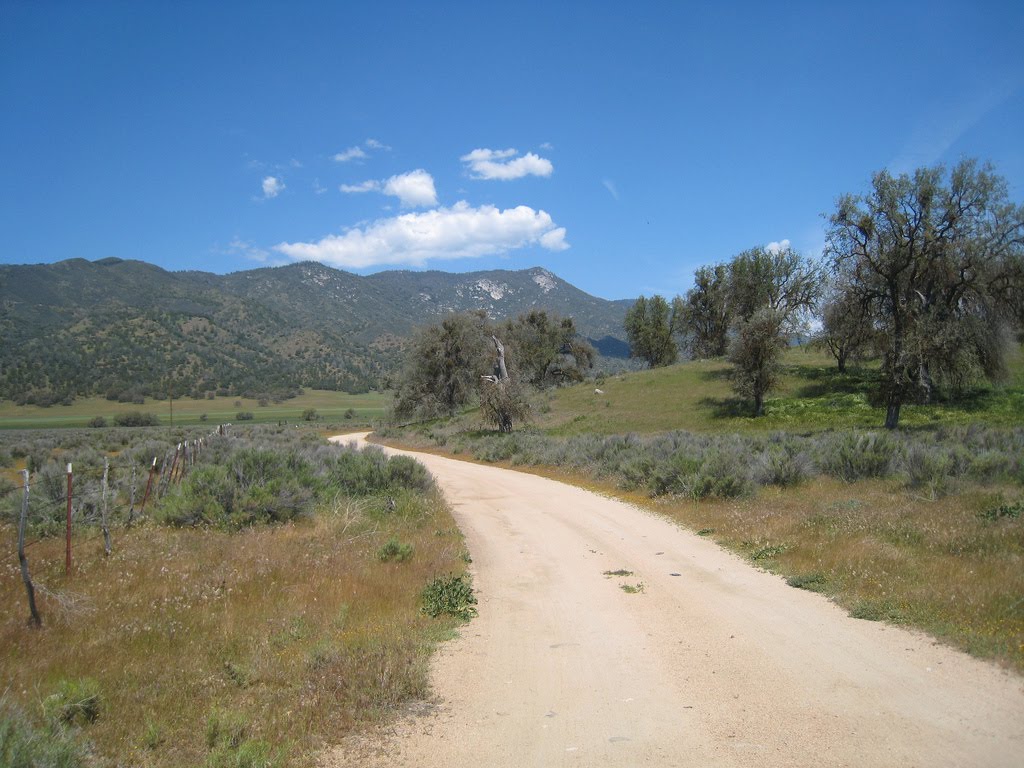
Walker Basin area. No, the race was not on the dirt road. Photo courtesy of Jill Eyres.
We started off and made our way through the first loop. The pack was staying together although there were surges now and then. On the outbound long stretch, the pack really slowed and often, no one would pull through to the front. There was a strong headwind here. I went out as did Deanna and also riders from Tibco II, Metromint and Dolce Vita (and probably others that I missed). But once someone started pulling, there were not many willing to take the reigns it seemed. After taking a turn pulling, my approach was to just keep slowing until it was semi-ridiculous and someone would eventually pull through. I felt comfortable in the pack, moving around. I wanted to be near the front for the first lap while we got used to the course, and also wanted to stay close to the front in order to try for some points and test a finish strategy. We made our way around and were starting on the short descent and I decided to just go for it to get ahead at that point. Well, I was ahead at the beginning of the climb but you know how this story ends... I was passed by two then more people right before the finish line. Dang! There was a gal from Metalmtn who stayed back and then just powered up that hill like she did hill sprints in her sleep. Anyway, I decided that the effort was probably not worth the few seconds I would gain, and decided to try and conserve a bit more, working for a better finish for this race and saving energy for the afternoon.
The pack stayed together and I tried to work up toward the front on the last straightaway stretch. People were jockeying for good spots and I was probably in the front third but not as far up as I would have liked. We got to the hill and I was jamming it, feeling pretty good, but needed to shift to my small chain ring. I tried and tried but it was stuck and the hill was getting steeper then BAM! it dropped and it felt like my chain had come off. But it hadn't. Some people passed me and I was mad but I got it going and worked to keep ahead of the gal beside me. She had contested the first hill points and I had passed her then. Everyone finishing with the pack was given the same time, which was A-OK with me.
Michal, Deanna and I warmed down and then jetted out of there pretty quickly to get to the Havilah Climb race site. We had about 4 hours to recover before the next race. We found some prime parking in the shade and started refueling and resting for stage 3. I was sort of guessing on how to manage my blood sugar since I had never done two longer (longer than 1 hour) races back to back like this. Before I got on the course, my blood sugar was a little on the low side; I was hoping I didn't have too much insulin buzzing around. I ate a chocolate GU and headed to the start.
The pack stayed together and I tried to work up toward the front on the last straightaway stretch. People were jockeying for good spots and I was probably in the front third but not as far up as I would have liked. We got to the hill and I was jamming it, feeling pretty good, but needed to shift to my small chain ring. I tried and tried but it was stuck and the hill was getting steeper then BAM! it dropped and it felt like my chain had come off. But it hadn't. Some people passed me and I was mad but I got it going and worked to keep ahead of the gal beside me. She had contested the first hill points and I had passed her then. Everyone finishing with the pack was given the same time, which was A-OK with me.
Michal, Deanna and I warmed down and then jetted out of there pretty quickly to get to the Havilah Climb race site. We had about 4 hours to recover before the next race. We found some prime parking in the shade and started refueling and resting for stage 3. I was sort of guessing on how to manage my blood sugar since I had never done two longer (longer than 1 hour) races back to back like this. Before I got on the course, my blood sugar was a little on the low side; I was hoping I didn't have too much insulin buzzing around. I ate a chocolate GU and headed to the start.

Pinning my number while resting up for stage 3. Photo courtesy of Jill Eyres.
Stage 3: Havilah Hill Climb (~11 mi), May 15, 2010, 3 PM, hot in the sun, cooler at the top
We staged the race on the dirt road at the entryway to the ranch where we had been resting. No one seemed able to tell us exactly how many miles we had to go. 17? 13? 15? No one seemed to know, although we were pretty sure we would have 4 miles before we got to the base of the main climb. We started on a gradual climb--someone had said it was a neutral roll out--with Deanna setting a manageable pace. Because of this, the pack stayed together for about 3.5 miles on what was actually a pretty steady climb (as I noticed more on the return trip). Some people eventually got impatient and the pace took off. We turned the corner and started the real climb. I stayed with the main pack for a couple turns but then decided to focus on holding my own pace. I lacked some zing in my legs and so ate a bit. I stayed with a couple riders for a couple miles and then felt myself fading. I ate some more but just felt crappy. I wondered if my blood sugar was low but thought it might also be high. I should have checked it but I didn't want to stop. I think I ate some more but with about 3 miles to go I felt really horrible. Michal passed me, motoring up and looking strong. I was happy to see her having a good race. Our good friend Julie Nevitt (category 3, racing masters) passed me around 1 or 2 miles to go and asked how I was. I knew from my response that my blood sugar was low, since I could just barely mumble out, "Okay." I was so happy to see Laurel around the last corner and finally made it to the top. I finally pulled out my Dexcom and saw "45" and that it had been like that for the past 30-40 minutes. Ugh, no wonder. I think one reason I didn't check coming up is that when I see that, it totally deflates any remaining motivation since I start to get scared. On the other hand, my doctor would probably pull me out if he saw that. I should have stopped to check. Michal took care of me at the top and helped me fuel up on watermelon and I recovered okay. I was glad to see Deanna finish and we took some time to relax at the top a bit. The total distance was 11 miles or so, I believe, with about 7 miles of serious climbing. I was disappointed that I hadn't been able to give it my all, and felt like perhaps the race was over for me, in terms of reaching my goal to place well in the GC. At least there was some great practice descending for 7 miles on twisty, gravelly roads! I pounded out my frustration on the final 4-mile, fast descent back to our cars.

Trying to put on a smiley face after a frustrating race.
We all more or less willingly took an ice bath that night, knowing we had one big race to go. While I was reflecting that evening, I decided that I should just try and forget about whatever time I had lost. Who knew what would happen?
Stage 4: Iron Hill Road Race (~46 mi), May 16, 2010, 8:45 AM
I had taken a look at a course map from mapmyride.com and from what I could tell, we started on a longer descent. Because of this, I really wanted to be in the front. We started about 15 min late and people were huddling under the shade. It was hot. Soon enough we were off and I was on the front down the first hill. Surprisingly, to me, though, it was more rolling the first several miles; I stayed in the front trying to set a good pace, expecting a longer descent at the top of each roller. I felt like I was working pretty hard to keep the pace up as we climbed each roller. Finally I moved back although I tried to stay close to the front. We rode over the cattle guard (that could "kill you" if you rode over the middle according to the race official) and could see that the real descent was imminent. Jill from Tibco II went to the front and set the pace down the hill. I had not been quite at the front and was about 10 riders back, with a little separation and taking the inside line. I came around a corner and saw a cloud of dirt off the side of the road, and then another rider down in the middle of the lane. Oh no. "Don't stop don't stop" was what went through my mind as my urge to stop and help kicked in. (What I realized later is that in the moment, I was not thinking at all of anyone behind me, but only the rider who was down in front. Thus it was crucial that I remembered and followed the "don't stop" rule that had been drilled into us by the mentors. It made me feel totally inhuman at the moment but that was because there was not time to process the danger to those behind me as well. Once I passed I remembered that there was a follow car behind us and that they would be given assistance.) I slowed to avoid the rider and water bottles but was able to navigate around since I had taken the inside line. I moved quickly to catch the group ahead and we finished the descent in silence. Once it leveled off, everyone started talking about the crash. One gal admitted to taking a line too wide and brushing the rider who came around her to the outside and who went down after the encounter. The conversation continued, focused on the crash. It was getting a bit negative and icky for me so after a few minutes of this I felt like it was time to move on and get things going. Talking about the crash was not helping us to have a safer race at this point. Jill from Tibco II, Christine from Dolce Vita and I set up a paceline; I wanted to take advantage of our break, which I felt had not been caused by the crash since I was behind it when it happened. Still I sort of wondered if doing so at that time was a negative thing to do. We had been riding comfortably for about 5 minutes, though, and still had a break and so it was time to get going.
It took about 10 minutes to get things moving more smoothly in our rotating paceline. One gal would pull off but not drift back and then the whole line would stall. After this happened a few times, I rode up to her and just asked if she wanted to participate in a paceline. "Oh! Okay!" We increased the pace on this flatter section and our group of 8 continued until the next longer descent, where we dropped one rider. I tried to hold up the group a little, but it didn't really work. The momentum was moving fast and I didn't want to get dropped, too, so I picked it up again. I had seen a really huge-looking hill on the profile and I kept expecting it at any moment. It was when we started on the last big descent of the first loop that I realized we had already gone over the hills and that this course had a lot more flat and descending sections that I had thought. Being in our paceline really helped make the climbs easier, since they weren't so steep that it became a truly individual effort.

Photo from the course by Jill Eyres.
Everyone chatted about the descent on the second loop and that we would all take it single file. I wanted to be in the front, since I felt like I would naturally descend faster and wanted to keep it a comfortable but fast speed. We all made it down safely and moved through the second lap. I was a lot more conscientious about drinking water and eating every 40 min or so, since I knew it was hot out. I was able to check my continuous glucose meter, and could see that I was in an okay zone. What a huge relief. We made it to the feed zone and I was so excited to see Laurel. "Laurel, Laurel, I'm in the break! I'm in the break!" was what I was thinking but instead I yelled out "My bike computer is in the dirt!" since it had fallen off on the short dirt section right before. Thank goodness Laurel picked it up! It would have been a super long and annoying trek out there otherwise, on top of a super long drive back to San Francisco. The second time up the longer hill was tiring and felt never-ending; we could hear some music playing in the follow car behind us and someone asked them to turn it up. So momentarily we were treated to some 90s rock music? I can't recall the name but it I enjoyed the mini-party. I had no computer and had no idea if we had 5 or 10 miles to go, so was so happy when he called out, "4 miles to go!" Hallelujah! Finally, we hit the descent, which had a lot of cornering but was not too technical, and rolled in close to Woody. I knew the finish was a long climb and thought I would get dropped. But then, in some effort at positive self-talk, I thought, "Hey Anne, you stayed with this group the whole time. You belong!" But I got dropped anyway (ugh!) and didn't have the energy to really push it harder. I think there was one gal I could have beaten but knew from riding almost two laps with everyone that we had some super strong climbers in the group. I also knew I wouldn't beat any of them for the GC, since the next time closest to me coming into this race was about 3 minutes faster. (Thank goodness I had looked at the results beforehand.) But I didn't want to slack too much because I had no idea how close people were coming from behind. I just pushed through the interminable last 1 km and finally, finally reached the finish. Lina from Metromint saved me by giving me a full bottle of chilled water after the finish. My legs were ready to start a cramp fest.
Coming into this stage, I was about 11 minutes back; I noted that no one else seemed to pull in for about that time, or a little more. Everyone in the break was ahead of me in the GC so my big hope was that we put enough time on the rest of the field for me to move up to 7th place. And when it was all said and done, I finished with about a 1-min gap faster than 8th place and so was very happy to finish 7th in the GC.
I think stage races are my favorite road events, since the multi-day strategy adds a fun twist. Also, with the various types of races, Kern balanced out peoples' strengths and weaknesses. This particular event had a very friendly atmosphere and I got to know the other women pretty well by the end. Of course it also provides a great opportunity to get to know each other on the team. Also, Bob Leibold really makes the award ceremony special. I would highly recommend this for everyone next year! It takes 100 women for them to break even financially. He currently puts this event on at a financial loss--it would be awesome to be able to support someone who is doing so much for women's racing in Nor Cal.

Early Birds Deanna, Michal, myself and team director Laurel (back) relaxing after a tough 3 days.
Sunday, June 06, 2010
The Short Story
Memorial Day weekend, I was caught up in a crash that occurred directly in front of me while racing at the Hellyer Velodrome. The most significant injury was an open fracture of my clavicle, which was surgically repaired the next day. The following day, Monday, I was discharged and returned to San Francisco. Early Tuesday morning, I felt severe pain in my right side, lower rib cage area. I thought it was an undiagnosed rib fracture perhaps, but wasn't sure. The pain would subside and then return. It made breathing difficult although I was not short of breath. I was worried I had experienced some head trauma and that I might not be getting enough O2 to my brain. Late afternoon, I checked into the ER, where they determined I had 3 small blood clots in my lungs. I was admitted to the hospital immediately and started on IV heparin to help dissolve the clots. They would never really tell me I would make it through the whole thing so it was pretty traumatic. I stayed in the hospital for 2 more days while they started adjusting my INR, which is the measure of how much the blood is clotting. They want mine between 2 and 3. I am taking a heparin injection (Lovenox) twice a day and warfarin (Coumadin aka rat poison) once a day to bring my levels up. On Thursday when I was discharged, I was at 1.5. While on warfarin, I am at risk for severe bleeding if I experience any trauma, so bike racing is obviously out. I think cycling is out in general, since even a slow-moving fall could result in serious injury. Also, "strenuous" exercise is out according to my doctor--such as exercise that might put a lot of strain on the muscles. (!!) I am finding it really hard to get any medical advice on what that means, exactly, since I don't exactly fit the typical profile for people on blood thinners. My doctor said most of his patients are elderly and that he doesn't have anyone in their 30s or 40s. I don't think he can really understand my life. I feel like I have been given a 6 month sentence and that I am now this fragile person--"Handle with care." I think my body and mind were primed from the trauma last year, and it has been hard. It is devastating to me because I had worked really hard to recover physically and mentally from last year, and was just at the point where everything was coming together. Now, I find myself at the beginning again. But this time, I don't know where I am heading.
I should add, on a more positive note, that I have gotten through this completely from the support of friends and family. Thank you for your visits, calls, emails, flowers and other gifts. I am very grateful. Also, the clots seem to be dissolving so the long term prognosis is good.
Subscribe to:
Comments (Atom)